 ChatGPT
 Claude
 Perplexity
 Google AI
 Grok
Grok
Author

Total Knee Replacement (TKR) has evolved significantly over the past few decades. What was once a largely manual, experience-driven procedure has now become a highly precise, technology-supported surgery. One of the most important advancements in this journey is the introduction of three-dimensional (3D) planning and workflow.
The 3D workflow in knee replacement surgery allows surgeons to visualise each patient’s knee anatomy in exceptional detail, plan the procedure with greater accuracy, and execute the surgery with improved alignment and balance. This step-by-step approach brings consistency, predictability, and confidence, both for surgeons and for patients undergoing the procedure.
This article explains how the 3D workflow works in total knee replacement, from imaging to surgical execution, and why it is increasingly becoming a valuable tool in modern orthopaedic care.
The process begins well before the patient enters the operating theatre. Instead of relying only on standard X-rays, surgeons now use CT-based 3D planning for TKR to capture detailed images of the knee joint.
A CT scan provides a comprehensive view of:
These scans generate high-resolution cross-sectional images that are then converted into a digital 3D model of the patient’s knee. This model accurately represents the patient’s unique anatomy, including subtle variations that may not be clearly visible on traditional imaging.
This step forms the foundation of the entire workflow. The more accurate the imaging, the more precise the planning and execution will be.
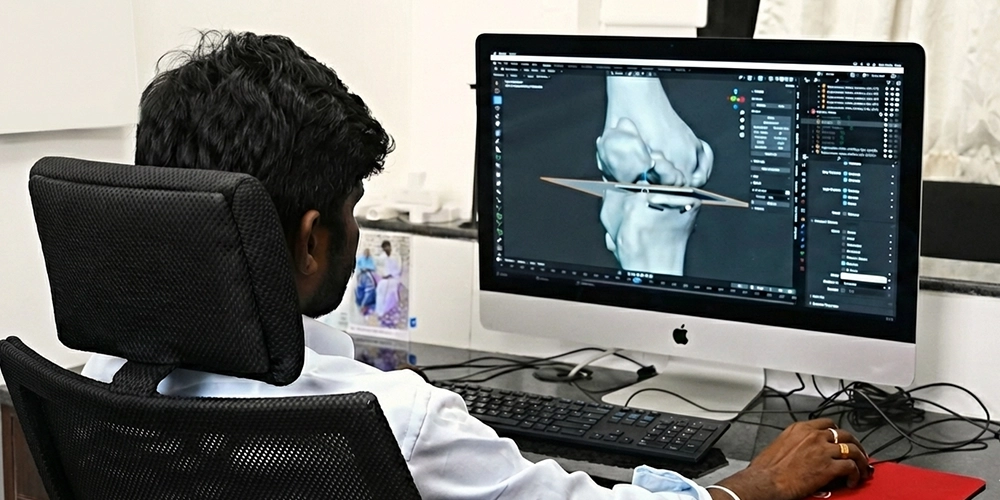
Once the CT data is collected, specialised software transforms the images into a three-dimensional virtual model of the knee joint. This digital replica allows the surgeon to examine the knee from every angle.
At this stage, the surgeon can:
This is a critical advantage of the 3D planning process for total knee replacement. Instead of working with general anatomical assumptions, surgeons can now plan the surgery based on the exact structure of the patient’s knee.
After the 3D model is created, the surgeon begins virtual surgical planning. This step is where technology truly enhances surgical decision-making.
Using the software, the surgeon can:
The ability to simulate the surgery in advance allows the surgeon to anticipate challenges and refine the plan before entering the operating room. Multiple implant positions can be tested virtually until the most suitable alignment and fit are achieved.
This level of preparation significantly reduces guesswork during surgery and improves consistency in outcomes.
Once the virtual plan is finalised, it is translated into the operating theatre. Depending on the surgical system used, this may involve patient-specific guides, navigation systems, or robotic assistance.
In all cases, the goal remains the same: to reproduce the pre-planned surgical steps with high accuracy.
During the operation, the surgeon:
The 3D workflow in knee replacement surgery supports precision while preserving the surgeon’s control and judgement. Technology assists the process, but the surgeon’s expertise continues to guide every decision.
One of the most critical factors in the success of total knee replacement is accurate implant alignment. Even small deviations can affect joint function, wear patterns, and long-term durability.
With 3D planning:
This personalised approach helps restore a more natural feeling knee, improves stability, and may reduce stress on surrounding ligaments and tissues.
The benefits of the 3D workflow extend beyond the operating room. Postoperative assessment becomes more structured and objective when surgery follows a detailed preoperative plan.
Surgeons can:
Patients often benefit from improved confidence in movement, better early function, and a clearer understanding of their recovery process.
The shift toward 3D planning represents a broader change in orthopaedics, from standardised procedures to patient-specific care.
Key advantages include:
While long-term outcomes depend on multiple factors, including rehabilitation and overall health, the precision offered by 3D workflows plays a meaningful role in optimising results.
At Soundarapandian Bone and Joint Hospital, the focus remains on combining clinical expertise with proven technological advancements. The use of structured planning, careful execution, and evidence-based techniques reflects a commitment to delivering reliable and patient-focused orthopaedic care.
The 3D workflow in total knee replacement is not about replacing surgical skill; it is about enhancing it. By understanding the knee in three dimensions and planning every step, surgeons are better equipped to restore mobility, relieve pain, and help patients return to daily life with confidence.

 Virtual Tour
 Book an Appointment
 What's App