

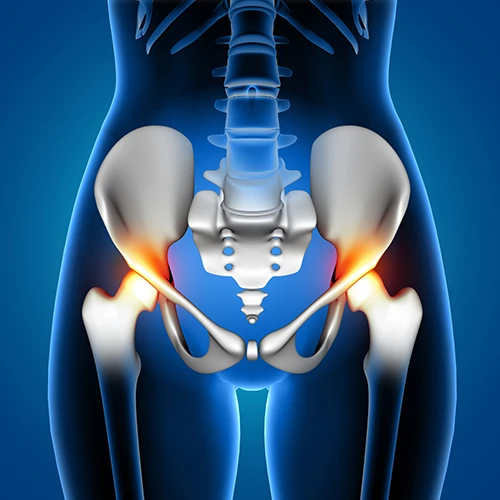
The Steps Behind a Successful Total Hip Replacement
- General or spinal anaesthesia is administered to ensure the patient feels no pain during surgery.
- The surgeon makes an incision along the hip to access the hip joint. The incision size can vary depending on the surgical technique (traditional vs. minimally invasive).
- The damaged hip joint is carefully dislocated to allow access to the femoral head (ball of the hip joint).
- The damaged femoral head is removed, and the hip socket is cleaned of damaged cartilage and bone.
- Acetabular Component: A metal or ceramic cup (the new hip socket) is inserted into the pelvic bone.
- Femoral Component: A metal or ceramic stem (the new femoral head) is inserted into the thigh bone (femur), sometimes using bone cement to secure it.
- A plastic or ceramic liner is placed inside the new hip socket (acetabular component) to allow smooth joint movement.
- The new femoral head is attached to the femoral stem, and the joint is carefully realigned.
- The incision is closed with sutures or staples, and a sterile bandage is applied to the area.
- Post-surgery, the patient begins rehabilitation, focusing on regaining mobility, strength, and range of motion through physical therapy
The procedure typically takes 1-2 hours, depending on the complexity of the case and the surgeon’s approach.