 ChatGPT
 Claude
 Perplexity
 Google AI
 Grok
Author

When exploring modern solutions for severe knee arthritis, patients are frequently presented with two highly advertised, cutting-edge terms: robotic knee surgery and personalised knee replacement.
Because both technologies promise superior accuracy compared to traditional, manual surgeries, they are often mistakenly used interchangeably. However, they represent completely different surgical philosophies, workflows, and patient experiences. If you are looking to undergo a knee replacement, understanding this distinction is crucial to choosing the path that will best restore your quality of life.
Here is a breakdown of the key differences between robotic and personalised knee systems and why personalised care such as Soundrapandian’s proprietary PERFIT-R Knee System is transforming patient outcomes.
To understand robotic knee surgery, it is helpful to look at where the technology is applied. Robotic-assisted joint replacement is primarily an intraoperative tool.
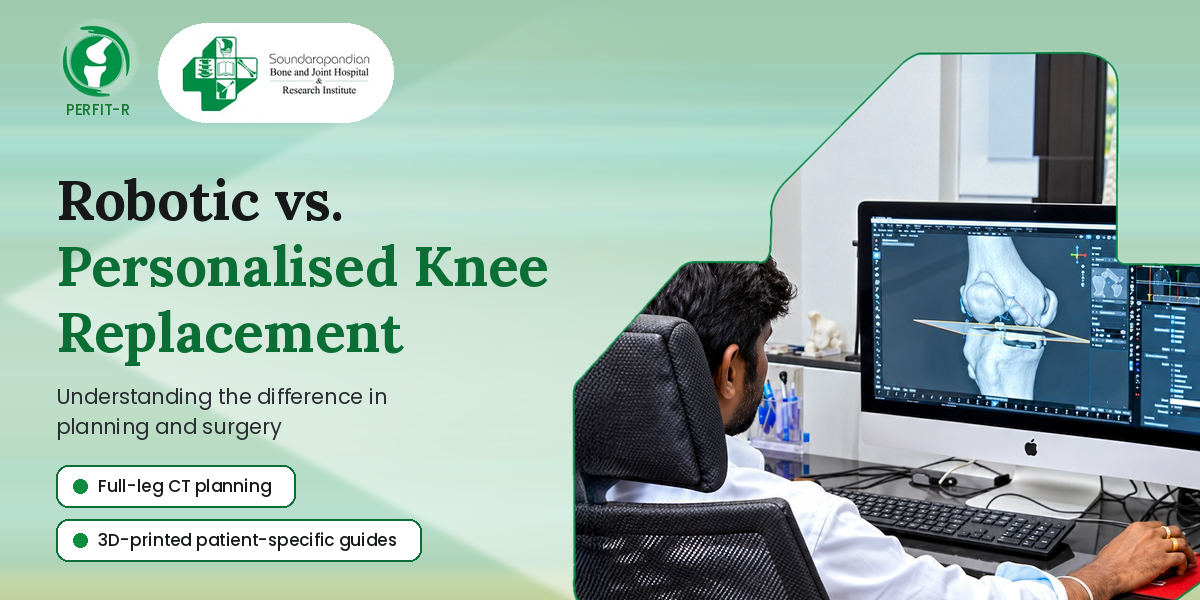
In contrast, a personalised knee replacement, exemplified by Soundrapandians’s PERFIT-R Knee System, is not just an intraoperative guide; it is a complete, custom-tailored ecosystem designed around your body’s exact anatomy.
Feature | Robotic Surgery | PERFIT-R |
Technology | Robotic assistance | 3D-printed custom guides |
Planning | Computer-guided | Full-leg CT and 3D planning |
During Surgery | Robot-guided cuts | Patient-specific jigs |
Setup | Requires calibration | Pre-planned before surgery |
Implant | Standard implant sizes | Personalised implant positioning |
Our natural walk is as unique as a fingerprint. The PERFIT-R system’s greatest advantage is its ability to restore your unique, native gait. Because the 3D-printed jigs allow surgeons to match the exact angles of your original bone structure, your soft tissues, ligaments, and muscles do not have to struggle to adapt to a foreign, robotic alignment. The aim is to align the implant with the patient’s own anatomy, which may help some patients return to daily activities. Results vary between individuals
Robotic surgery is a powerful execution tool, but it does not change the fact that standard implants are designed for an “average” knee rather than your knee. Deciding on the right knee replacement technology is a personal journey that depends on your unique anatomy and lifestyle goals. If you are ready to explore how Soundarapandian’s PERFIT-R Personalised Knee System can help you restore a natural, active gait, our specialised team is here to guide you. Schedule a consultation with our joint replacement specialists today to discuss your customised treatment plan.
Does robotic knee surgery use a special implant?
Usually, robotic systems assist the surgeon in positioning a standard knee implant. The robot does not manufacture a patient-specific implant.
Does PERFIT-R require a robot?
No. PERFIT-R transfers the preoperative 3D plan into surgery using patient-specific, 3D-printed cutting guides.
Which technique requires a CT scan?
This depends on the system used. PERFIT-R requires a full-leg CT scan to create the 3D model and personalised surgical guides.
Can either technique guarantee a natural-feeling knee?
No technique can guarantee a specific result. Knee function depends on surgical planning, implant positioning, soft-tissue balance, rehabilitation, and the patient’s overall health.
Is the surgeon still important when advanced technology is used?
Yes. Technology supports accuracy, but the surgeon’s experience, clinical decisions and surgical technique remain essential to the outcome.
How should I choose between robotic and personalised knee replacement?
Ask your surgeon how the surgery will be planned, how alignment and soft-tissue balance will be managed, and why the recommended method is suitable for your knee.

 Virtual Tour
 Book an Appointment
 What's App