
 ChatGPT
 Claude
 Perplexity
 Google AI
 Grok
Grok
How Is Scoliosis Diagnosed? X-Rays, Physical Exams, and Tests
Diagnosing scoliosis is not a single-step decision. It is a structured clinical process that helps doctors understand whether a spinal curve is present, how significant it is, and how it should be monitored over time. Because scoliosis can progress differently in each individual, especially during growth years, accurate diagnosis is essential for planning appropriate follow-up and care.
This article explains the diagnostic pathway used by clinicians, focusing on examinations, imaging, and tests that guide medical judgment.
When Does a Doctor Suspect Scoliosis?
Situations that may lead to evaluation include:
- Routine school or paediatric screenings
- Orthopaedic assessments during growth monitoring
- Evaluation of spinal alignment during unrelated medical visits
Once suspicion arises, a step-by-step diagnostic process follows.
Physical Exam for Scoliosis: What Doctors Look For
A physical exam for scoliosis is the first clinical tool used to assess spinal alignment. This examination helps determine whether further testing is needed.
Structured Observation
Doctors assess posture from multiple angles, paying attention to balance, symmetry, and how the spine behaves during movement rather than at rest alone.
Forward Bend Assessment
During this assessment, the patient bends forward while the examiner observes the back. This position helps highlight structural asymmetry that may not be visible while standing upright.
Functional Evaluation
Doctors also evaluate flexibility and spinal motion to understand whether the curve behaves structurally or changes with movement, an important distinction during diagnosis.
The physical exam does not confirm scoliosis but provides essential guidance for the next diagnostic steps.
Scoliosis Screening Methods and Their Role
Scoliosis screening methods are designed to identify individuals who may need further evaluation, not to establish a diagnosis.
Common screening settings include:
- School health programmes
- Annual paediatric examinations
- Pre-participation physical assessments
Screening helps identify spinal asymmetry early, particularly during periods of rapid growth, allowing timely referral for detailed evaluation.
X-Ray for Scoliosis Detection: Confirming the Diagnosis
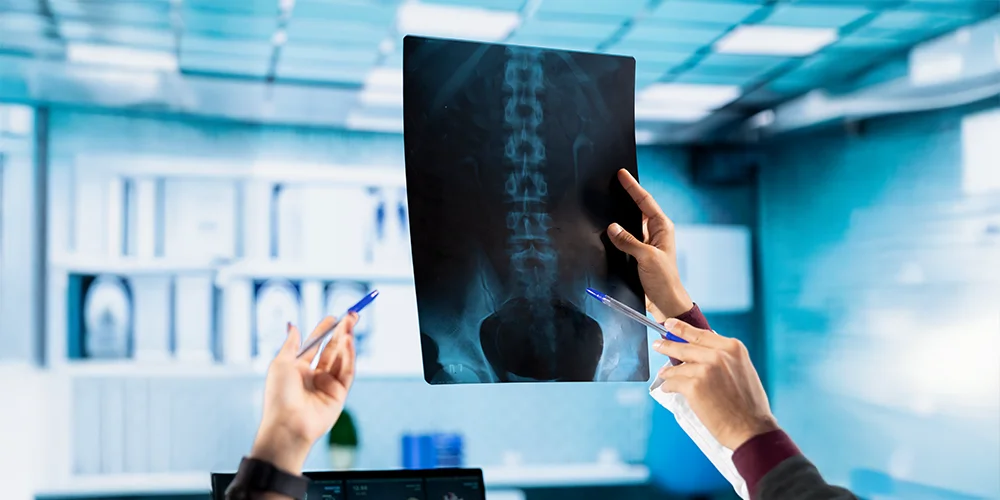
Once clinical suspicion is established, imaging becomes essential. An X-ray for scoliosis detection is the primary diagnostic tool used to confirm spinal curvature.
Why X-Rays Are Necessary
X-rays allow doctors to:
- Visualise spinal alignment under weight-bearing conditions
- Measure curve magnitude accurately
- Track changes over time using consistent reference points
Understanding Curve Measurement
Using standardised methods, clinicians quantify the curve to determine whether it meets diagnostic criteria and whether monitoring or intervention is required.
X-rays also help identify curve patterns, which are important for long-term planning and follow-up schedules.
How Doctors Check for Scoliosis Progression
Diagnosis is not always a one-time decision. Understanding how doctors check for scoliosis progression is a key part of patient care.
Doctors consider:
- Age and remaining growth potential
- Rate of curve change over time
- Spinal maturity indicators
Follow-up imaging is scheduled strategically to balance accuracy with safety, especially in younger patients.
Scoliosis Diagnosis in Children: A Growth-Focused Approach
Scoliosis diagnosis in children requires special consideration because spinal curves can change rapidly during growth spurts.
Doctors focus on:
- Timing of skeletal growth
- Curve stability over months
- Need for closer monitoring during developmental phases
Diagnosis in children is often followed by a structured observation plan rather than immediate intervention, depending on the curve behaviour.
When Are Additional Tests Recommended?
While X-rays and physical exams form the core of diagnosis, additional tests may be recommended in specific situations.
MRI or Advanced Imaging
These are advised if doctors suspect:
- Underlying neurological involvement
- Structural abnormalities present from birth
- Atypical curve patterns
Bone Maturity Assessment
Understanding skeletal maturity helps predict whether a curve is likely to progress, especially in adolescents.
These tests refine diagnosis rather than replace standard evaluation methods.
Diagnosis in Adolescents and Adults
In adolescents, diagnosis often occurs during growth monitoring. In adults, diagnosis may focus more on understanding curve stability and structural changes rather than progression risk.
Adult evaluation typically emphasises:
- Structural changes over time
- Impact on spinal balance
- Need for long-term monitoring
The diagnostic principles remain the same, but interpretation differs based on age and spinal maturity.
What Diagnosis Helps Doctors Decide
A confirmed diagnosis helps doctors determine:
- Whether monitoring alone is sufficient
- How often are follow-up assessments needed
- When intervention may become necessary
Diagnosis provides clarity, not urgency. Many individuals live comfortably with stable spinal curves that require observation rather than treatment.
FAQ
Is one X-ray enough to diagnose scoliosis?
An initial X-ray confirms the diagnosis, but follow-up images may be needed to monitor changes over time.
Do all children with spinal asymmetry have scoliosis?
No. Screening findings often require confirmation through imaging before a diagnosis is made.
Can scoliosis be overdiagnosed?
Careful measurement and clinical correlation help avoid misdiagnosis. Not all curves require treatment.
How long does the diagnostic process take?
Diagnosis may occur during a single visit, but monitoring over time is often part of the process.
Is the diagnosis different for adults?
The tools are similar, but doctors focus more on structural stability and long-term spinal health.
Can posture correction or exercise change a scoliosis diagnosis?
Posture and exercise can improve strength and comfort, but they do not alter the structural measurements used to diagnose scoliosis. Diagnosis is based on spinal alignment seen on imaging, not posture alone.
Why do doctors sometimes wait before confirming progression?
Scoliosis does not always progress in a straight line. Doctors often monitor changes over time to distinguish between temporary postural variations and true structural progression before making clinical decisions.